Is Km Dependent on Enzyme Concentration
The model takes the form of an equation describing the rate of enzymatic reactions by relating reaction rate rate of formation of product to the concentration of a substrate S. In the parenteral route the pharmacokinetic profile is log-linear and dose-dependent and to present a higher bioavailability of 78.

Untitled Document
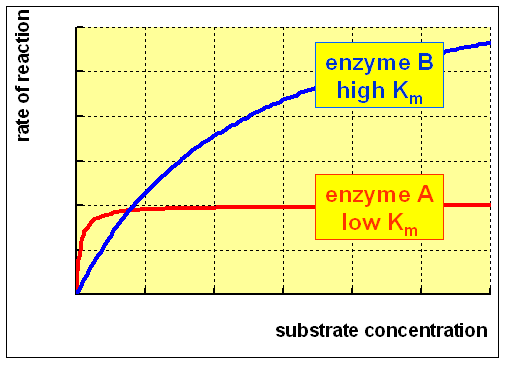
In other words the enzyme will be operating at 50 of it maximum possible rate when SKm.
. On the other hand if the enzyme is already fully used changing the concentration of the other materials will have no effect. Inhibition at low concentrations induction at high concentrations. For example enzymes speed up biological reactions and their concentration affects the rate of reaction.
This peak plasma concentration declines rapidly due to fast redistribution into liver spleen kidney and skeletal muscle. Some reports found the effects of Ginkgo biloba extracts on CYP are concentration-dependently ie. By substituting into equation 1 the values for S 10 and Km 1 you will see that by increasing the substrate concentration 10-fold the enzyme now works at 90 of it maximum possible rate instead of 50.
Normal intracellular concentrations of PRPP which can and do fluctuate are below the KM of the enzyme for PRPP so there is great potential for increasing the rate of the reaction by increasing the substrate concentration. In some studies a substrate-dependent fashion effects have been described. If km value is high then enzyme has high affinity and minute amount of.
The kinetics are sigmoidal. Now for each concentration of the substate used calculate velocity of the enzyme enzyme activity simply by dividing reaction time eg 40mM10 min 4mMmin. Km does not vary with enzyme concentration because km is not dependent on enzyme concentration.
It shows the enzymes affinity for the particular substrate ie. Studying an enzymes kinetics in this way can reveal the catalytic mechanism of this enzyme its role in metabolism how its activity is controlled and how a drug or a modifier. Effect of substrate concentration 852 Effect of enzyme Concentration As there is optimal substrate concentration rate of an enzymatic reaction or velocity V is directly proportional to the enzyme concentration.
Enzyme kinetics is the study of the rates of enzyme-catalysed chemical reactionsIn enzyme kinetics the reaction rate is measured and the effects of varying the conditions of the reaction are investigated. It is named after German biochemist Leonor Michaelis and Canadian physician Maud Menten. When SKm v Vmax S2S ie.
In biochemistry MichaelisMenten kinetics is one of the best-known models of enzyme kinetics. PRPP also can play a role in regulating the rate. Inconsistencies in the half-maximal 50 inhibitory concentration IC 50 data for anticancer chemotherapeutic agents have yielded irreproducible experimental results and thus reciprocally contradictory theories in modern cancer researchThe MTT assay is currently the most extensively used method for IC 50 measurements.
In that case changing the concentration of the catalyst can speed up or slow down the reaction. VVmax S2S ½. Presence of excess substrate and an increase in the enzyme concentration may result in some limitations.
Here we dissected the critical reasons.
Untitled Document
Why Doesn T Km Vary With Enzyme Concentration Quora

Km And Enzyme Kinetics Km Is An Essential But Misunderstood By Luke Hollomon M S Medium


Comments
Post a Comment